


Funding
Refreshing Slip, Slop, Slap, Seek, Slide for a New Generation
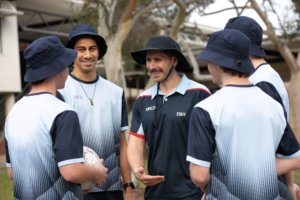
Researchers at the University of Sydney’s Prevention Research Collaboration are updating the NSW SunSmart program for secondary school audiences, supported by Sydney Health Partners and Cancer Council NSW.
Published date:
More than two in three Australians will be diagnosed with skin cancer in their lifetime, and childhood and adolescence are critical periods for protecting skin from the harmful effects of UV radiation. Supporting young people to establish sun-safe habits early in life is therefore a public health priority.
Cancer Council’s SunSmart program, known to many via the iconic Slip, Slop, Slap, Seek, Slide initiative, has been leading Australia’s sun safety efforts since the early 1980s. However, a recent review of the SunSmart program in NSW highlighted the need to make sun-safe behaviours more visible, relevant and achievable for secondary school students.
Now, a three-year project led by the University of Sydney’s Prevention Research Collaboration (PRC) in partnership with Sydney Health Partners, and Cancer Council NSW, is set to address this challenge head on by reimagining the SunSmart program for secondary school audiences.
Our goal is to create a SunSmart approach that feels contemporary, practical and relevant and that meets the needs of a very different education system to the one the original program began in.
Cancer Council NSW’s Skin Cancer Prevention Programs Lead, Claire Osborne
A Collaborative Approach to Skin Cancer Prevention
The project, led by Professor Philayrath Phongsavan, will leverage PRC’s leadership in translational public health research to produce a self-assessment rubric and implementation toolkit to support the uptake of a SunSmart program in secondary schools across NSW.
“PRC’s focus is applied, pragmatic research and translating evidence and research into practice, so a lot of the work we do is around primary prevention. Skin cancer prevention certainly fits within that remit,” says PRC Senior Research Fellow, Blythe O’Hara.
“In this project, we’re really focused on working with stakeholders to ensure we produce something that meets their needs. We’ll work with them to design the rubric and toolkit, and then we’ll test, evaluate and refine the outputs, continuously monitoring and improving as we go.”
The work will be guided by Sydney Health Partners’ recognised expertise in implementation science, Cancer Council NSW’s breadth of expertise in skin cancer prevention, and stakeholder engagement and insights from schools and young people.
The research is supported by $410,000 from the Nicholas and Phyllis Pinter Trust as managed by Equity Trustees, a major Australian independent trustee and executor company that also supports health and medical research. In 2025, Sydney Health Partners received $2 million from Equity Trustees to fund new research translation projects. Cancer Council NSW will provide additional funding support over the life of the SunSmart project.
Embedding Sun Safety in Everyday School Life
This project builds on an ongoing program of research to strengthen sun safe practices in NSW schools in the context of the current school environment and the endless demands teachers face to integrate new programs into established curricula. As such, the rubric and implementation toolkit will be developed to become part of the fabric of everyday school life.
“The clearest message that came through from all of our past consultations and research was that schools need flexible support that fits within their existing priorities and ways of working,” Claire says.
“That will really help us tailor support to schools’ individual contexts and build on existing strengths through a continuous improvement model. It’s about tailoring that starting point to an individual school’s readiness.”
The project commenced in July 2026.