


Event Report
Faster Pathways to Support for Children with Developmental Needs
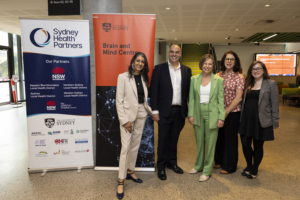
Research from the Sydney Health Partners (SHP) Child Development and Mental Health Clinical Academic Group (CAG) to automate child neurodevelopmental assessments in NSW is now informing the development of a national program.
Published date:
Both the original project and the national program address a pressing issue in health service delivery: children with neurodevelopmental disorders routinely wait months or even years for assessments that can connect them to life-changing interventions and support.
Funded by a $3 million Medical Research Future Fund (MRFF) National Critical Infrastructure Grant, the program was launched by the Hon Jenny McAllister MP, Minister for Disability and the National Disability Insurance Scheme at the University of Sydney’s Brain and Mind Centre earlier this month. It will develop an automated decision tool called the Neurodevelopment, Evaluation, Support and Tracking (NEST) Decision Assistant.
NEST will draw on data from the existing Australian Child Neurodevelopment Registry (ACNR) to rapidly stratify patients by symptom severity, predict the impacts on their functioning, and match them with more personalised, dynamic and proactive interventions.
“The aim is really to redesign a lot of the processes and assessment pathways so that they’re more fit for purpose for clinicians, but more importantly, for families and children,” says Professor Adam Guastella from the Children’s Hospital at Westmead, Co-chair of the SHP Child Development and Mental Health CAG and Chief Investigator on the MRFF-funded research program.
Using these tools will allow clinicians to more quickly assess patients and devote more time to ensuring that high-quality personalised care is made available to every Australian child and parent that needs it.
Professor Adam Guastella
Sowing the Seeds of Clinical Translation
Like any research, the current project builds on years of effort, including the establishment of the ACNR back in 2019. This work was led with another co-chair of SHP’s Child Development and Mental Health CAG, Associate Professor Natalie Silove, and a multidisciplinary team from the Sydney Children’s Hospitals Network. The ACNR draws on data from over 14 sites treating over 5,000 children, to better understand children’s developmental needs, experiences and outcomes across diverse Australian communities.
University of Sydney early-career researcher Dr Kelsie Boulton subsequently progressed this work by proposing a series of intersecting digital tools that could automate the scoring and reporting of child neurodevelopmental assessments. In 2022, the CAG leadership identified Dr Boulton’s project as a research priority and threw the group’s collective academic and clinical expertise behind its development. Dr Boulton received a 2023 SHP Implementation Science Grant valued at $20,000 to fund the work.
Dr Boulton’s project further embedded the ACNR within the Sydney Children’s Hospital Network into everyday clinical practice by drawing on its data to help clinicians more quickly and efficiently assess patients and refer them to care. The tools that emerged from her research have saved at least 691 hours of clinician time across more than 1,380 patient assessments in a single clinical service and have recently been expanded into another.
Three years after the project concluded, its impact continues to grow.
“The project enabled the development of the solution and tested its implementation in one service, but through Sydney Health Partners, we’ve been able to continue translating that into a growing number of services,” says Dr Boulton, whose research was further strengthened by attending an SHP Implementation Science Masterclass.
“There’s also a focus on continued capacity building beyond those initial outcomes. The CAG is always asking, ‘What’s the next step? Where do we go next? How are we expanding this?’ The MRFF grant is part of those next steps.”
The Exponential Power of Collaboration
These outcomes highlight the importance of SHP investment in clinical research that can be scaled beyond the local setting. Even as the MRFF program expands outside NSW, the Child Development and Mental Health CAG will continue to play a key role in its development.
“I think what’s going to emerge as we build is that the CAG will become the primary driver of the national delivery,” Professor Guastella says.
When trying to solve complex health issues for and with families, it necessarily requires a multidisciplinary, multi-targeted, large team working together. Sydney Health Partners provides a way for us to bring knowledge together across all of those areas.
Professor Adam Guastella